

Floral Conservation
Cemig is committed to achieving a sustainable balance between municipal development and the conservation of natural ecosystems. The Company actively engages in programs and projects aimed at the recovery and restoration of flora, as well as the management of urban tree planting. With a strong commitment to the environment, Cemig develops initiatives that ensure the preservation of native vegetation, contributing to the maintenance of biodiversity and the quality of life for the population.
Cemig seeks to establish strategic partnerships that contribute to ecosystem restoration and the environmental regularization of small farmers’ rural properties, in alignment with the state’s environmental public policies, the Sustainable Development Goals (SDGs), climate neutrality targets, and the Company’s ESG guidelines. To this end, in 2026, Cemig launched a public call for proposals to restore approximately 200 hectares of degraded areas across roughly 40 small-scale properties upstream of the Poço Fundo SHP reservoir. A total of R$6 million will be invested in the project. The project’s scope includes government agencies, companies, NGOs (Non-governamental Organization), universities, individuals, and rural landowners, with work expected to begin in late 2026.
Research and Development Project (R&D) 602
During the construction of the Emborcação Hydroelectric Plant (UHE), in the period between 1977 and 1981, an area of Cerrado, belonging to the district of Pedra Branca, municipality of Catalão, Goiás, was used as a loan area for the extraction of clay for the construction of the power plant.
After completion of the construction work on the Emborcação Hydroelectric Power Plant (UHE) in 1981, Cemig used techniques to rehabilitate the borrowed area, installing a vegetation cover on the ground and stabilizing the area, which was sold to third parties in 1987.
Thus, in order to promote the recovery of that area, the research project: “Strategies to accelerate ecological succession in degraded areas around UHE Emborcação: ecological services performed by animals, in favor of environmental restoration”, was proposed and started on August 02, 2018 with a duration of 48 months. It counts, in its development, with the participation of the Federal University of Ouro Preto (UFOP), Federal University of Minas Gerais (UFMG), Federal University of Uberlândia (UFU), University of Brasília (UNB), Gorceix Foundation and Cemig Geração e Transmission S/A (CEMIG GT).
This project aims to propose and test techniques for recovering degraded areas, using new technologies and aiming at the installation of islands of ecological succession, using fauna as a source of colonizing species, within the scope of UHE Emborcação.
The Research Project comprises 12 subprojects, 9 of which have already been concluded. Among the results obtained, the effectiveness of applying the topsoil transposition methodology stands out, which proved to be a low-cost methodology for recovering the area. Another methodology that we could cite would be the use of dung beetles, as secondary seed dispersers, being a complementary technique for the recovery of these areas. Also noteworthy is the use of artificial perches associated with other types of attractions, such as shelter and/or food items, to attract seed-dispersing birds in the area, which contribute to the recovery of the environment.
It should be noted that one of the products that will be obtained by R&D GT602 is a manual for the recovery of degraded areas, which will be used in the recovery of CEMIG areas and will greatly contribute to the entire Brazilian energy sector.
Research and Development Project (R&D) 551
The 551 Project titled “Characterization of Reference Ecosystems and Implementation of Models for the Restoration of Degraded Areas in the Fartura RPPN,” was carried out between 2013 and 2018, in partnership with the Minas Gerais State Research Support Foundation (Fapemig), Cemig Distribuição S.A., and Cemig Geração e Transmissão S.A.
The main objective of the project was to provide information on techniques and procedures for the restoration of degraded areas at different levels of impact, as well as the control of invasive plants in the Fartura Private Natural Heritage Reserve (RPPN), located in Capelinha (MG).
To this end, reference parameters were established based on preserved remnants of the Fartura RPPN, generating essential information for the evaluation of environmental restoration projects. Different techniques and models for restoring vegetation cover were implemented and tested, enabling the identification of the most effective strategies for restoring degraded areas within the reserve.
Several publications have resulted from these studies. In addition, relevant information has been generated regarding reference ecosystems of the Atlantic Forest at different stages of conservation. These data can be used to establish seed banks to support future ecological restoration programs in the Jequitinhonha region, thereby strengthening conservation efforts.
Forest Compensation
It is worth mentioning that, with the formation of the large reservoirs of hydroelectric plants, a large perimeter is created on their banks, normally devoid of forest formations. When existing, these formations are made up of species adapted to a drier environment and, therefore, poorly adapted to high soil moisture due to the rise in the water table and fluctuations in the level of the reservoir.
This new configuration of the environment creates the need for implantation, recovery and conservation of riparian forests around the reservoirs in order to maintain ecological processes.
For almost 30 years, Cemig has been developing, in partnership with universities, several studies that have supported programs for the implantation of riparian forests around its reservoirs. Through R&D Programs, the Company has sought to study and propose innovations in the face of the technological challenges of the electricity sector. The partnership with rural producers around its reservoirs has been fundamental for the success of these actions.
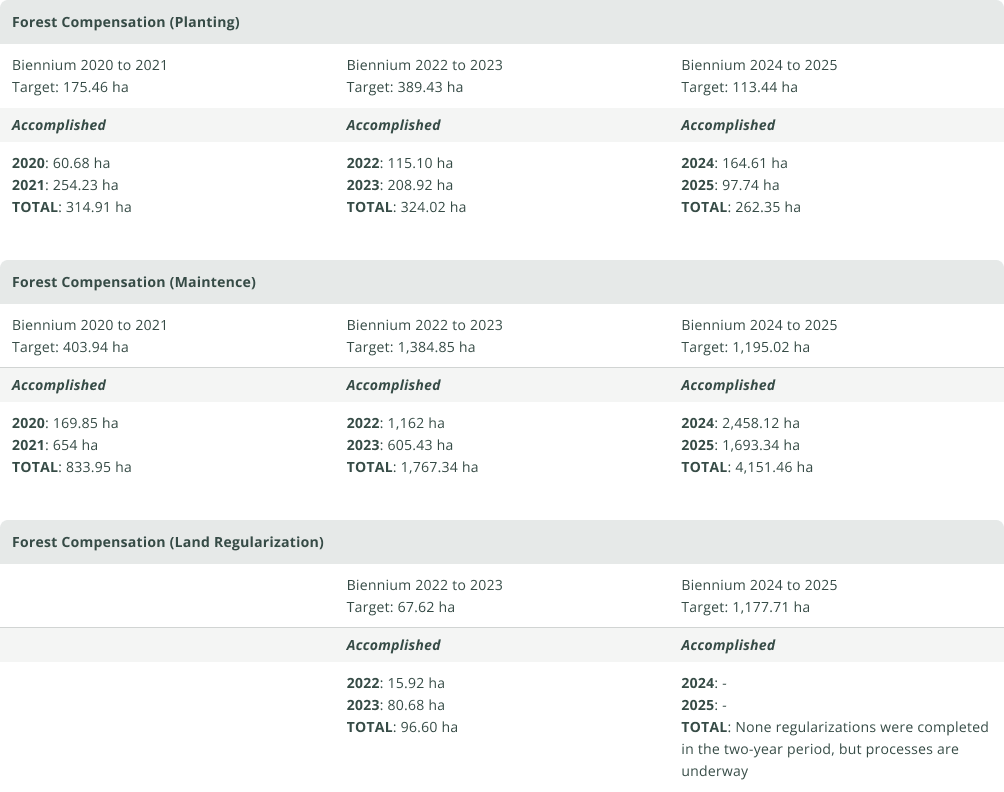
Cemig seeks to implement strategies to compensate for deforestation resulting from its Distribution expansion activities, committing itself to the planting of native plant species and the recovery of degraded areas. To this end, it established targets and deadlines for forest compensation whose progressions are shown considering planting, maintenance and land regularization, since 2020 in Cemig Geração e Transmissão S.A. and at Cemig Distribuição S.A..
Forest Compensation: Goals and achievement per biennium at Cemig GT and Cemig D
Itutinga Environmental Station
The Itutinga Environmental Station (EAITU), inaugurated in July 1994, with an area of 3.52 hectares, has an infrastructure that comprises 01 (one) Pisciculture Laboratory and 01 (one) seedling nursery. The Station is located in the municipality of Itutinga, at Km 306 of BR 265, between the Itutinga and Camargos HPP buses, close to the cities of Lavras and São João Del Rei.
The seedling nursery works with native species recommended and identified in two groups: Pioneers (PI), with fast growth and that produce fruits attractive to the fauna and Climax (CL), demanding of light, are those species of intermediate growth and that appear in the last stage of forest succession.
The production of seedlings takes place through the sowing or cutting process, and the seeds and cuttings are collected in the region surrounding the Environmental Station. After germination of the seeds or sprouting of the cuttings in greenhouses, these are transferred to tubes and are cultivated until they reach average sizes between 30 and 40 cm, depending on the species.
A minimum monthly production (from January to November of each year) of 2,500 seedlings/month of native species is foreseen, 50% with pioneer species (PI) and 50% with climax species (CL), totaling 22,000 seedlings/year, considering a average loss of 10% per year. These native seedlings produced will be used for revegetation in planting riparian forests, recovery of degraded areas and for protection of springs.
The Station also supports environmental education activities through monitored visits of the nursery and nearby hydroelectric power plants (Itutinga and Camargos HPPs) for students and other interested.
Conservation Units
The Conservation Units are spaces protected by law which aim at the preservation and conservation of nature. Law No. 9,985, of July 18, 2000, establishes the National System of Nature Conservation Units– SNUC which defines criteria and guidelines for the creation, implementation and management of these protected areas.
Conservation units are divided into two groups called Full Protection Units, whose objective is to preserve nature, with only the indirect use of its natural resources being allowed Sustainable Use Units that combine nature conservation with sustainable use.
Standing out in the category of Sustainable Use Units is the RPPN – Private Natural Heritage Reserve, which is a private area, in which a term of perpetuity is signed between the environmental agency and the owner, which is recorded in the registration in the Public Registry of Properties. The purpose of RPPNs is to conserve biological diversity by contributing to the expansion of protected areas in the country with the possibility of collaboration between public and private initiative. It allows scientific research and visitation for tourist, recreational and educational purposes, as provided for in the unit’s Management Plan.
Cemig has three RPPNs in the state of Minas Gerais, the RPPN Galheiro located in the Minas Gerais triangle region, the RPPN Coronel Domiciano in the southern portion of the state and the RPPN Fatura in the north of Minas, in the Jequitinhonha Valley region.
RPPN Coronel Domiciano Plant
A The RPPN Usina Coronel Domiciano is inserted in the territories of the Minas Gerais municipalities of Muriaé and Rosário da Limeira. This reserve was created in the year 2000, being recognized by the State Institute of Forests (IEF) through IEF ordinance nº 18/00. It is located in the Zona da Mata Mineira region, inserted in the Atlantic Forest biome and is of great importance for the conservation of fauna and flora species belonging to this biome.
The management plan for the RPPN Usina Coronel Domiciano was approved by the State Institute of Forests IEF in 2021 and provides for the following programs:
- Protection Program
- Environmental Education and Visitation Program
- Altered Area Recovery Program
- Scientific Research Program
RPPN Galheiro
The Galheiro Natural Heritage Private Reserve was created in 1995 by Ordinance No. 73-N of the Brazilian Institute for the Environment and Renewable Natural Resources (IBAMA) and is located in the municipality of Perdizes, Minas Gerais. In this region, the native vegetation is composed of a mosaic of phytophysiognomies such as the Forested Savannah, the Arborizada Savannah, the Gallery Forests, among others. It is an area of great biological importance, which holds a plant heritage for the Triângulo Mineiro region and for Brazil, with approximately 2,700 ha.
Flora survey studies in the Galheiro Natural Heritage Private Reserve have shown a great richness of species in the Cerrado biome and a continuous variation in floristic composition throughout its extension, a very relevant characteristic for the preservation of the region’s fauna. In this RPPN, more than 1,200 species and 148 families of plants have already been catalogued.
Currently, this reserve has a Management Plan, published in 2015 by ICMBio (Chico Mendes Institute for Biodiversity Conservation) and updated by Cemig in 2022. As a result, the unit carries out various activities related to environmental education and the promotion of scientific research. . Educational signage, with visual impact signs for visitors, selective collection and maintenance of accommodation for receiving students and researchers are some of them.
RPPN Fartura
No In the municipality of Capelinha, in the Jequitinhonha Valley, in Minas Gerais, Cemig maintains the Fartura RPPN (Private Natural Heritage Reserve). The Sustainable Use Conservation Unit, which has an area of 1,455 ha, was created in 2009 by Ordinance No. 189 of the State Institute of Forests of Minas Gerais (IEF), consolidating the property’s perpetual destination as a reserve.
During the environmental licensing process for the Irapé Hydroelectric Power Plant (Usina Presidente Juscelino Kubitschek), located on the Jequitinhonha River, there was a need to resettle the communities of Jacuba and Bocaina, both located in Turmalina (MG). For this purpose, land was acquired in the municipality of Capelinha, where there was an important remnant of Atlantic Forest, whose richness of fauna and flora should be preserved mainly because it is in an ecotone zone (environmental transition) with the Cerrado biome. Thus, an agreement was signed with the IEF to transform the site called Fazenda Fartura into a protected area, giving rise to the RPPN.
According to the survey carried out by the Federal University of the Jequitinhonha and Mucuri Valleys (UFVJM), in 2016, the region has 278 species, belonging to 144 genera and 55 botanical families. Among the registered species, 17 have not yet been identified. The Research and Development project, R&D 551, entitled Characterization of Reference Ecosystems and Implementation of Models for the Recovery of Degraded Areas in RPPN Fartura, ended in 2018 and produced a book and booklets containing important guidelines on agroforestry systems, springs, fires, among others. other. The material can be accessed below, in the attachments section.
In this RPPN, Cemig also carries out actions within the Environmental Education Program to raise awareness of the care and conservation of the natural and cultural resources of the conservation unit and its surroundings. The Reserve’s Management Plan also provides for protection of the area and prevention against fires, activities that are being maintained by Cemig, in addition to stimulating scientific research whose partnership with the UFVJM has generated important scientific data on the region’s flora.