

Peixe Vivo Program
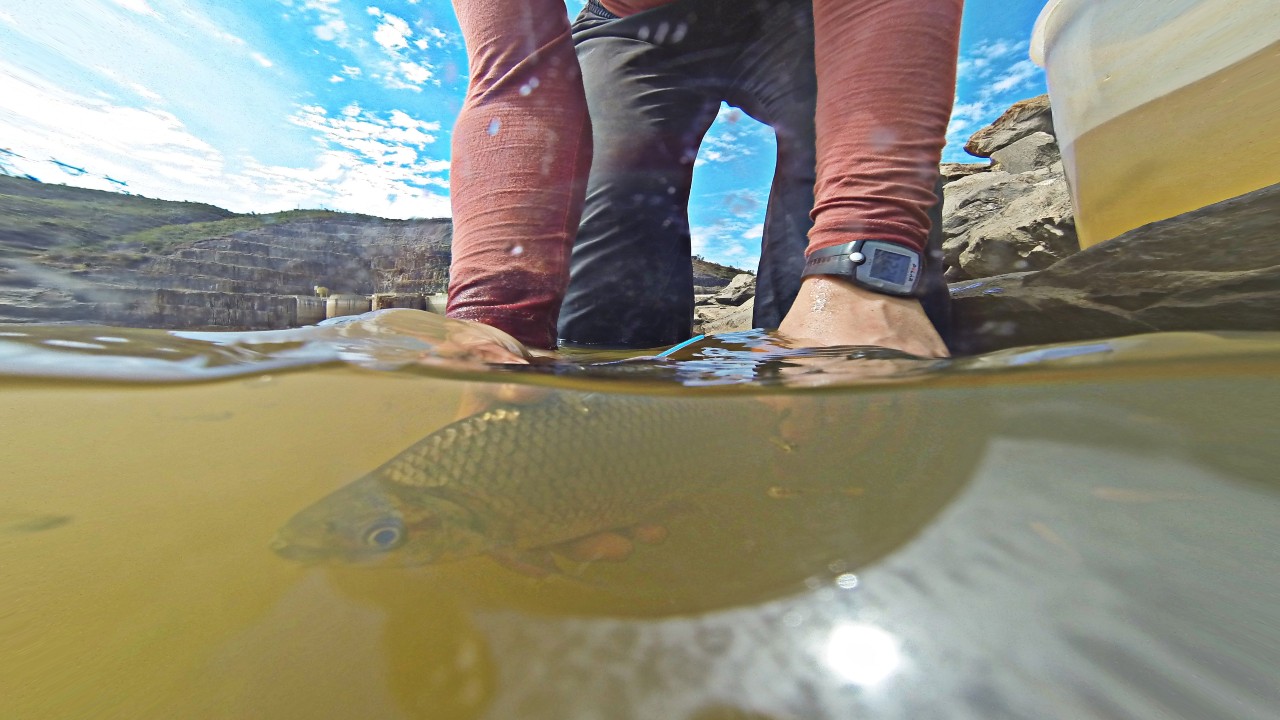
The “Peixe Vivo” (Living Fish) Program was created in 2007 and since its creation, it operates on two fronts – one that aims at preserving fish populations in the State of Minas Gerais, through funding and support for research projects, and the other focused on the formation of protection strategies to avoid and prevent the death of fish in Cemig’s hydroelectric power plants.
After more than 15 years of activities, the Program is recognized for conducting improvements in practices related to ichthyofauna in the electrical sector. The positive impacts of the program are reflected in the significant reduction in fish deaths and, consequently, in environmental fines, in the improvement of management and conservation programs with solid scientific bases and the participation in the indexes of the company’s sustainability.
Mission
Its primary mission is to minimize the impact on the ichthyofauna, seeking solutions and management technologies that integrate the generation of electricity by Cemig with the conservation of native fish species.
Vision
Expanding Cemig’s performance in strategic actions that ensure the conservation of native fish in the watersheds where the company operates and promoting environmental public policies based on technical/scientific knowledge, through the integration of the different sectors involved in the subject, long-term planning and optimization of resource use.
Principals
- Adopt scientific criteria for decision-making.
- Change practices adopted according to generated information.
- Encouraging the disclosure of the program information to society
- Work in collaboration with other institutions.
Program Pillars
The activities of “Peixe Vivo” (Living Fish) Program are guided and directed by three pillars:
- Research and development;
- Management and conservation;
- Relationship with the community.
Table of Projects:
| Number | Title | Main Goal | Institutions involved | Coordinator | |
|---|---|---|---|---|---|
| CT 511 | Chronic Fish Deaths at Cemig Group Hydroelectric Power Plants | Understand the causes and propose measures to reduce chronic fish deaths in Cemig group plants. | UFMG | Alexandre Lima Godinho | 2018-2022 |
| Ru0026amp;D 611 | Decommissioning of PCH Pandeiros: an unprecedented experience in South America | Evaluate the possible impacts of removing the Pandeiros dam on the river and its different components to support a decision on the matter. | UFLA, UFMG | Eduardo van den Berg | 2019-2023 |
| Ru0026amp;D 612 | Importance of stretches of free rivers for the environmental context in dam regions: integrating new technologies for the study of ichthyofauna | Diagnose the importance of free rivers for the conservation of native migratory ichthyofauna in watersheds already dammed by hydroelectric projects, based on two approaches: understanding migratory patterns of fish from the upper São Francisco and; evaluating the spatial and temporal distribution of fish in the cascade of Itutinga and Camargos reservoirs, Rio Grande basin. | UFLA | Paulo dos Santos Pompeu | 2019-2022 |
| Ru0026amp;D 624 | Diagnosis of conditions for spawning and recruitment of migratory fish species upstream and downstream of the Três Marias HPP | Characterize the conditions for spawning and recruitment of migratory fish species, establishing a conceptual model for these events in the studied area. At the same time, prepare a manual on larvae from the São Francisco river basin. | PUC-Minas | Gilmar Bastos Santos | 2019-2022 |
| Ru0026amp;D 624 | Diagnosis of conditions for spawning and recruitment of migratory fish species upstream and downstream of the Três Marias HPP | Characterize the conditions for spawning and recruitment of migratory fish species, establishing a conceptual model for these events in the studied area. At the same time, prepare a manual on larvae from the São Francisco river basin. | PUC-Minas | Gilmar Bastos Santos | 2019-2022 |
| Ru0026amp;D 635 | Use of innovative tools for the detection and monitoring of fish in freshwater environments | Develop innovative methodologies for monitoring fish in reservoirs, combining traditional techniques with echo sounding and sampling of environmental DNA. Also, create a specific database that allows the historical evaluation of fish monitoring carried out by Cemig. | UFLA, PUC-Minas | Paulo dos Santos Pompeu | 2019-2022 |